

AIR4NRG PUSHES FOR LONG-DURATION ENERGY STORAGE REGULATION AT BRIDGE KNOWLEDGE SHARING SESSION
Europe’s clean energy transition relies on long-duration energy storage (LDES), yet the lack of a clear regulatory framework threatens its development. At the BRIDGE Working Group on Regulation’s Knowledge Sharing Session 2, Air4NRG’s Scientific Coordinator, David Guyomarch’h, highlighted the urgent need for policy action to support LDES technologies and ensure their role in Europe’s future energy system.
The transition to renewable energy is accelerating, but the lack of a clear regulatory framework for long-duration energy storage (LDES) threatens to slow its progress. Without well-defined policies, investment in storage technologies remains risky, delaying the large-scale deployment needed to stabilise the grid and secure Europe’s energy independence.
This challenge was at the centre of discussions at the BRIDGE Working Group on Regulation’s Knowledge Sharing Session 2, where David Guyomarch’h, Air4NRG’s Scientific Coordinator from SEGULA Technologies, represented the project. His intervention focused on the urgent need to integrate LDES solutions into European policies, ensuring that these technologies can play their crucial role in balancing renewable energy supply and demand.
Despite growing recognition of storage as a key enabler of decarbonisation, European policies still lack a clear definition of what qualifies as long-duration storage. This contrasts with other global leaders, such as the United States and the United Kingdom, where specific policies for LDES are already in place. Without regulatory clarity, projects like Air4NRG—which is developing an Isothermal Compressed Air Energy Storage (I-CAES) system—face significant barriers to industrialisation.
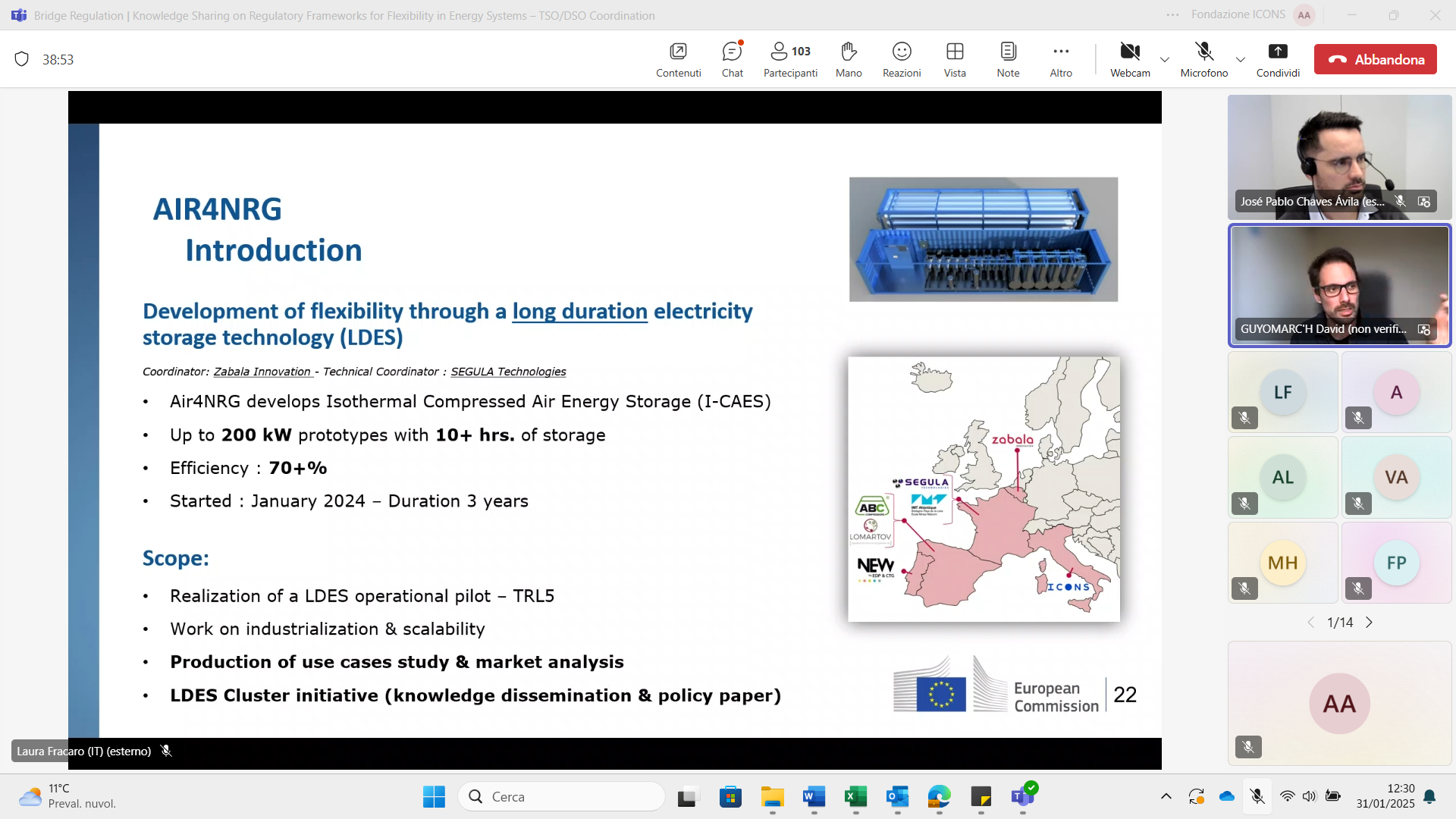
Guyomarch’h highlighted how current EU electricity market structures primarily focus on short-term flexibility, leaving LDES overlooked in key regulations. This lack of recognition limits investment, as long-duration storage requires high upfront costs and long development cycles, with few guaranteed revenue streams. Investors remain hesitant, and the absence of financial incentives further slows progress.
Air4NRG is actively working to change this narrative. Through its participation in the LDES Cluster, alongside SEHRENE and SCO2OP-TES, the project is advocating for stronger policy support and a dedicated regulatory framework. The cluster, supported by the Horizon Results Booster, is working on joint dissemination efforts to bring LDES to the forefront of EU policy discussions. The goal is to ensure that decision-makers understand the critical role of LDES in enabling a secure, flexible, and decarbonised energy system.
The BRIDGE session provided an opportunity for Air4NRG to engage directly with policymakers and fellow energy storage experts, reinforcing the need for long-term solutions in Europe’s energy transition. Guyomarch’h’s presentation outlined the key regulatory gaps that need to be addressed, calling for a shift in market design that recognises LDES as an essential component of the future energy mix.
As discussions on the future of energy storage policy continue, Air4NRG and its partners remain committed to pushing for change. The project’s ongoing engagement with BRIDGE, alongside planned policy-focused events and publications, aims to shape the regulatory landscape, ensuring that LDES technologies receive the recognition and support needed to scale up and drive Europe’s clean energy future.
* Cover photo by Karsten Würth on Unsplash
